India is home to some of the world’s most ambitious scientific programs. From the achievements of Indian Space Research Organisation to advances in biotechnology, artificial intelligence, vaccine production, climate science, and digital infrastructure, the country has emerged as a major scientific power. Yet, despite this progress, science journalism in India remains surprisingly weak, fragmented, and underdeveloped.
Most mainstream media in India treat science as a “second fiddle.” Political controversies, elections, celebrity gossip, crime, and entertainment are alway headlines, while scientific developments receive minimum attention. As a result, a large gap has emerged between science and society.
The weakness of science journalism in India is not caused by a single problem. It is the outcome of structural, economic, educational, linguistic, and cultural factors that together prevent science reporting from becoming a strong pillar of Indian media.
What Is Science Journalism?
Science journalism means reporting and writing about scientific discoveries, inventions and research in a way that ordinary people can understand. It also involves questioning scientists, companies, and institutions about issues like ethics, money, safety, and the impact of science on society.
It acts as a bridge between scientists and society. In a country like India, where public health, climate change, agriculture, education, and technology deeply affect millions, this role becomes even more important.
The Historical Problem: Science Was Never a Core Media Priority
Indian journalism historically evolved around politics, nationalism, governance, and social issues. During colonial times and after independence, newspapers focused heavily on political mobilization and public affairs. Science reporting remained niche and limited to government announcements or educational supplements.
Even though institutions like National Council for Science and Technology Communication were created to promote scientific temper, science journalism never developed into a robust newsroom culture.
| The National Council for Science and Technology Communication (NCSTC) is a Government of India programme established in 1982 after the government introduced a science communication plan during India’s Sixth Five-Year Plan. NCSTC was created to spread scientific knowledge among people and promote scientific temper and thinking in society. It works under the Department of Science and Technology and aims to make science and technology easier for the common public to understand. |
Unlike countries such as the United States or the United Kingdom, India did not build a strong ecosystem of specialized science correspondents, science magazines, or investigative science desks. As television news exploded in the 1990s and digital media expanded later, science lost even more space to sensational and fast-paced content.
TRP and Clickbait Culture Damaged Science Reporting
Modern Indian media operates in a highly competitive attention economy. News organizations prioritize stories that generate:
- High television ratings (TRP)
- Social media engagement
- Fast clicks
- Emotional reactions
Science journalism usually requires patience, verification, context, and careful explanation. But sensational political debates or celebrity controversies generate quicker profits.
As a result:
- Science stories are often simplified excessively
- Headlines become misleading
- Preliminary research gets presented as “breakthrough”
- Nuanced findings are ignored
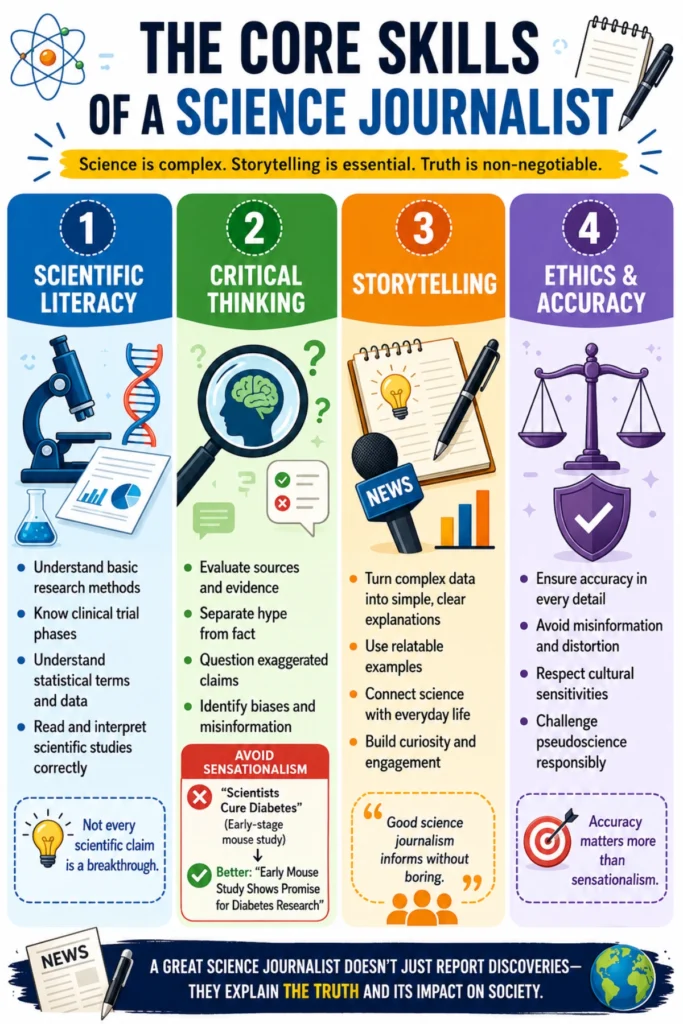
For example, early-stage medical studies are frequently reported as miracle cures. Research done on mice may be portrayed as a near-human solution. This weakens public trust over time.
Several studies on science communication globally have highlighted how misinformation and sensationalism increasingly affect science reporting ecosystems.
Lack of Specialized Science Journalists
One of the biggest weaknesses is the shortage of trained science journalists.
Most Indian journalists covering science are general reporters with limited scientific training. They may not fully understand:
- Clinical trial phases
- Statistical significance
- Peer review systems
- Research methodology
- Data interpretation
- Scientific uncertainty
As a result, many reports rely heavily on press releases instead of independent analysis.
India also has very few journalism schools offering specialized science journalism programs. Even major media houses lack dedicated science desks. This creates a situation where science reporting becomes customary and event-driven rather than analytical.
Research on science journalism globally also points out that shrinking newsroom resources and increasing workloads reduce the quality of science reporting.
Language Barrier: Science Remains Trapped in English
India’s linguistic diversity creates another major challenge.
Most scientific communication in India happens in English, while a large portion of the population consumes news in Hindi or regional languages.
This creates two separate information worlds:
| English-speaking urban India | Regional-language India |
|---|---|
| Access to science explainers | Limited science coverage |
| Research discussions | Reliance on WhatsApp forwards |
| International scientific news | Pseudoscience and rumors spread faster |
Because quality science journalism in regional languages remains limited, misinformation frequently fills the vacuum.
This problem became extremely visible during the COVID-19 pandemic when false cures, conspiracy theories, and fake medical claims spread rapidly across social media platforms in India.
Weak Scientific Temper in Society
India has outstanding scientists and engineers, but public scientific literacy remains uneven.
Many people can use advanced technology without fully understanding scientific reasoning. Superstition, miracle claims, astrology-based programming, and pseudoscientific narratives continue to receive mainstream media attention.
Science journalism struggles in an environment where:
- Rational questioning is sometimes unpopular
- Emotional narratives spread faster than evidence
- Television debates reward noise over accuracy
- Scientific uncertainty is misunderstood as weakness
Ironically, some media channels give equal importance to verified science and unverified claims in the name of “balance.” But science is not a political debate where every opinion carries equal weight.
Science journalism experts have repeatedly argued that evidence-based reporting is essential because false balance can mislead audiences about scientific consensus.
Social Media Changed the Information Ecosystem
The rise of platforms like YouTube, Instagram, and WhatsApp transformed science communication.
This has both positive and negative consequences.
Positive Effects
- Independent science creators emerged
- Young audiences consume explainers online
- Podcasts and short videos increased accessibility
- Scientists can communicate directly with audiences
Negative Effects
- Fake news spreads rapidly
- Algorithms reward sensational claims
- Influencers without expertise gain authority
- AI-generated misinformation is increasing
The modern information ecosystem now produces what researchers call an “infodemic”, an overload of both accurate and false information.
Science Journalism Without Investigation
Strong science journalism should investigate:
- Fake medical claims
- Research fraud
- Environmental violations
- Pharmaceutical lobbying
- Unsafe technologies
- Manipulated scientific data
But investigative science journalism in India remains rare because it requires:
- Technical expertise
- Legal support
- Time
- Funding
- Editorial backing
Organizations like India Research Watch have recently highlighted growing concerns around research misconduct and paper retractions in Indian academia.
However, sustained investigative reporting on scientific misconduct is still limited compared to political journalism.
Science Is Treated as “Soft News”
In many Indian newsrooms:
- Political journalism is “serious”
- Business journalism is “important”
- Entertainment journalism is “profitable”
- Science journalism is treated as optional
This mindset affects budgets, hiring, and editorial priorities.
Science stories are frequently assigned to junior reporters or published only on special occasions like rocket launches, Nobel Prizes, or disease outbreaks.
This episodic approach prevents the creation of a scientifically informed public culture.
The Education System Also Shares Responsibility
Indian education heavily emphasizes rote learning and exam performance. Students often memorize formulas without developing curiosity about scientific thinking.
As a result:
- Science becomes associated with exams, not public life
- Critical thinking remains weak
- People struggle to evaluate scientific claims independently
A stronger culture of questioning and evidence-based reasoning would naturally create demand for better science journalism.
Why Strong Science Journalism Matters for India
Weak science journalism is not merely a media problem. It directly affects democracy, public health, and national development.
Poor science reporting can lead to:
- Vaccine hesitancy
- Panic during epidemics
- Climate misinformation
- Spread of pseudoscience
- Public confusion about technology
- Distrust in scientific institutions
On the other hand, strong science journalism can help India:
- Build scientific temper
- Improve public policy debates
- Encourage innovation
- Fight misinformation
- Promote rational citizenship
In a country of 1.4 billion people facing climate challenges, health crises, AI disruption, and technological transformation, science journalism is no longer optional, it is essential infrastructure for democracy.
How India Can Strengthen Science Journalism
1. Create Dedicated Science Desks
Major media houses need specialized science teams with trained reporters.
2. Improve Regional Language Science Reporting
Science journalism must expand in Hindi and regional languages.
3. Introduce Science Journalism Courses
Universities should offer professional programs combining journalism and scientific literacy.
4. Encourage Scientist–Media Collaboration
Scientists should receive communication training, while journalists should gain scientific literacy.
5. Fund Independent Science Media
Nonprofit and independent science journalism platforms need grants and institutional support.
6. Promote Fact-Checking Ecosystems
AI-assisted verification and scientific fact-checking systems can help combat misinformation.
7. Reward Slow and Analytical Journalism
Science reporting requires depth, not just speed.
Conclusion
Science journalism in India is weak not because India lacks science, but because the ecosystem surrounding science communication remains underdeveloped.
The country produces world-class scientists, launches space missions, develops vaccines, and leads digital innovation — yet public understanding of science often remains shallow and vulnerable to misinformation.
The real challenge is not scientific capability; it is scientific communication.
If India wants to become a true knowledge society, science journalism must move from the margins of media to its center. A democracy that cannot communicate science effectively risks becoming technologically advanced but scientifically confused.
Leave a Reply